I did not know it yet, but the ordinary shape of that morning was about to become the last normal thing I trusted. It was a morning like every other: wake up, take the dog out, make a cup of coffee, and open the laptop. A rhythm so familiar it felt like a hug from my favorite aunt. But when I opened Outlook, the meeting invite sat at the top of my inbox. It had been sent at 6:30 a.m. PST: "Important Business Update," with me and more than forty of my coworkers included. That was the moment I started to question why this update was only for some of us.
When I joined the 9 a.m. call, I knew something was about to happen. Not because I knew some corporate secret, but because the most recent business blog had warned that another wave of layoffs was coming across big tech. Still, I went into the call hopeful. I was in the room with people who held critical operations roles, so part of me believed we were safe. Then I noticed my skip manager was not on camera with HR. Her manager was there instead: our organization's most senior leader. The one we only saw when he had time, or at town halls where he talked at us, not with us.
"Hello, everyone," he said, his voice somber. "Thank you for joining this last-minute meeting." Then came the pause. We all waited on the same deep inhale, bracing for the next sentence. "Because of the great work this team has done, we have achieved some important things. But we have had to make a decision about the path forward. It is with a heavy heart that I share this business decision: your roles have been impacted, and your work will no longer be required."
Everything started to sound like a high-pitched scream. I could hear what he was saying, but the words no longer arrived as sentences. I was processing the emotional impact of it all against the weight of a life that had already felt stressful before that call ever appeared on my calendar.
After three more minutes of my organization's leader filling the silence, he announced his exit, and that was it. HR then went through the checklist: things to say, links to share, and next steps we should expect. After a fifteen-minute call, more than forty of us hung up no longer having jobs.
I closed my laptop, walked over to my husband, and hugged him. I did not cry. I did not yell. I just needed that hug.
I looked up at him and said, "We will be fine. We will be fine…" Then I asked, "Right?"
Two months in, we were fine. Things were busy. Life felt light, but it would be silly not to admit there was a new kind of wonder hanging over our home now: how long? How long would it be until I found my next role?
But I believed it would be soon because I had a great resume. My network leaned in with feedback, formatting, and real support from people in the kinds of roles that make decisions. I felt covered. Recruiters were calling, and interview loops were starting. It was going to happen.
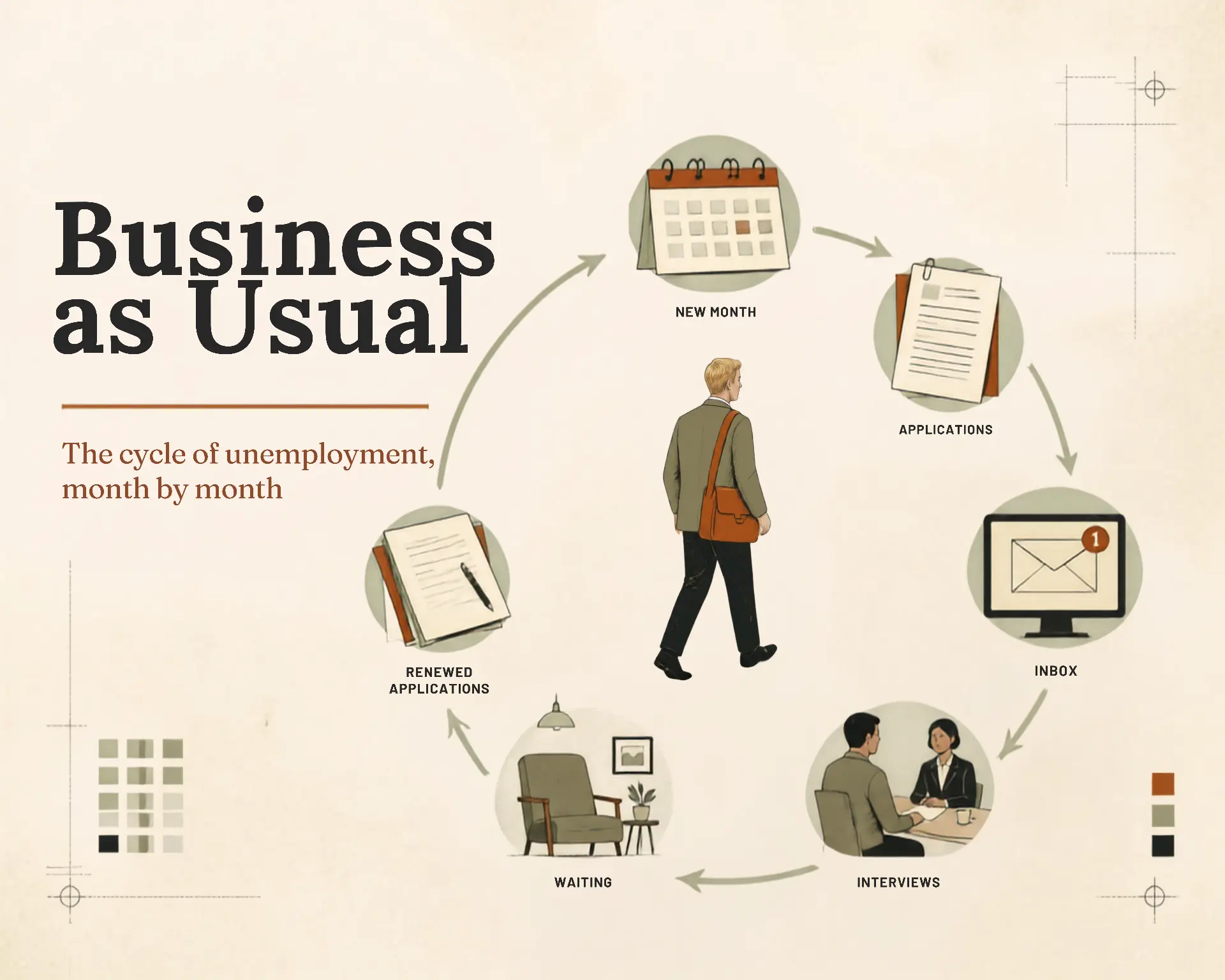
In fact, one morning over coffee, at the same dining room table where I had joined that 9 a.m. meeting and been laid off, I was on my laptop refreshing my email to see if there were any updates from interviews or jobs I had applied for. My mornings were starting to look very different than they had before all of this. I still had coffee, but I was not joining a meeting. No, now I was scrolling LinkedIn by 9 a.m., updating my job—or rather, rejection—tracker. Already at fifty.
I refreshed my email and saw that the hiring manager had asked if I had a moment to talk that day. I got butterflies. I was excited. I really wanted this job. It aligned with my goals, but more than that, I saw it as a career milestone I thought I deserved. I thought I had earned it, and it was time. So, of course, I made myself available. Honestly, I did not have a thing to do, which somehow made my eagerness feel even louder.
It was 11 a.m. this time. I opened the laptop and saw the hiring manager on video. I smiled and said, "Hello! How are you?" in that eager-to-hear-what-you-have-to-say-because-I-had-been-thinking-about-it-since-you-emailed-at-9-a.m. tone. I knew that tone too well.
"Hello, Joshua. Great to see you. I am good, thanks for asking," she said, showing a small smile. My stomach dropped. I knew this feeling. I knew that smile. I knew where we were about to go in this conversation.
"…the team thought you were really talented. They said you had some great ideas and did a great job walking them through your thought process and how you approach this work…" I held my small smile, waiting for the other side of her sentence to reveal itself.
"But they ultimately left feeling unsure if you could do the work. So we ended up going with another candidate." I looked at her like I had not understood a single thing she had just said. I could not even open my mouth to ask another question except, "What would have made them more comfortable knowing I could do the work?" Because this was not going to be a waste of my time. I was going to ask the question. I deserved the answer.
After she paused, she said, "You know, that is a great question. And if I'm honest, I'd have to get back to you." We wrapped up the call shortly after that, and I went to my husband and said, "Another no." He stood up, ready to give me that hug. The hug I always needed these days. But before he did, he said, "We will be fine." I repeated it back. Then I said to myself, "Right?"
Nine months had passed. Two hundred fifty "we went with another candidate" emails. I was tired. Frankly, I was overwhelmed. This was way longer than I had ever imagined being unemployed. I knew people. I had a network. At least, I thought I did.
Now it was a new year, and I was sitting on the sofa, eating a protein bar, skimming emails, and waiting for the only open-loop outcome I had left. I sipped my coffee and let myself feel hopeful. This role felt like the role of all roles. I knew so many of the interviewers in the loop. It was a small world, and everything felt lined up. This was the "yes" I had been dreaming of. I just knew it.
Until I saw the <noreply@> email with the position update and job number. They said no. Officially, 251 noes.
But this one stung deeper. I stopped and yelled to my husband in the office, "They said no." I tried to make it light. "Back to LinkedIn, I guess." I picked up my coffee and took a sip, but the sting started to feel physical. My arms and legs went numb. A high-pitched ringing filled my ears, and I felt dizzy.
I yelled, "Hey, babe… I don't feel okay." He had already started walking out to the living room when I yelled the first time, so he came to me immediately and told me to breathe. We took deep breaths together. He took my coffee and brought me water. We kept breathing together for another twenty or thirty seconds.
Then he told me to lie down, and I did. I needed a nap. I needed a moment to recenter and ground myself in my truth, not in the value I had started assigning to myself because of 251 rejections while everyone around me kept moving as if nothing had changed.
I wanted to be business as usual, too. But no. I was lying on my sofa, having my first panic attack because that job, that hiring manager, that divisional leader, all of it, was gone without a word on why.
I stayed there for almost two hours, letting my body come back to itself. My brain kept making stories out of the silence—whole lives that would not happen now, rooms I would not walk into, work I would not get to begin. On the sofa, all of it felt real. Every imagined ending had weight. That was what unemployment had been teaching me slowly: a no could arrive in one sentence and still take up the whole room.
My husband came to the edge of the sofa, leaned over, and asked softly, "You okay?" I smiled and said, "Yes… thank you."
I stood up and said, "I think I needed that moment to process. It all came running toward me with that last no." I walked to the kitchen for a refill of water. "I just knew that was the job. I was already thinking about what I wanted to do on day one. And to not even get a why, from people I know and respect, is really hard."
What I did not say was that I had begun turning every rejection into testimony. Not just about my resume or my interview answers, but about whether I was still someone a room would choose.
I turned toward the dining table. The same table where, nine months earlier, I had learned my role was no longer "business required." The same table where I had gotten the no for the role where my "ability to do the work" was questioned.
There sat my husband with his laptop. He looked at me and said, "Come sit." I sat next to him and sipped my new cup of iced water. I looked into his brown eyes, and with his hand on mine, he said, "We will continue to be fine."
I took a deep breath and said, "I think so too. I mean, we've figured it out this far. We will continue." He smiled. Then I said, "What other choice do we have? The bills are not going to pay themselves."
We laughed, and the day kept moving. Another morning full of weather inside me. Another afternoon asking ordinary things of us anyway: dishes, bills, emails, water glasses sweating on the table. Nothing had been solved. No door had opened. But something in the room had steadied. Maybe being fine was not the same as being untouched. Maybe being fine was the two of us at the dining room table, choosing the next breath, the next plan, the next day.
That was our business as usual now: not certainty, not ease, just the quiet work of continuing.